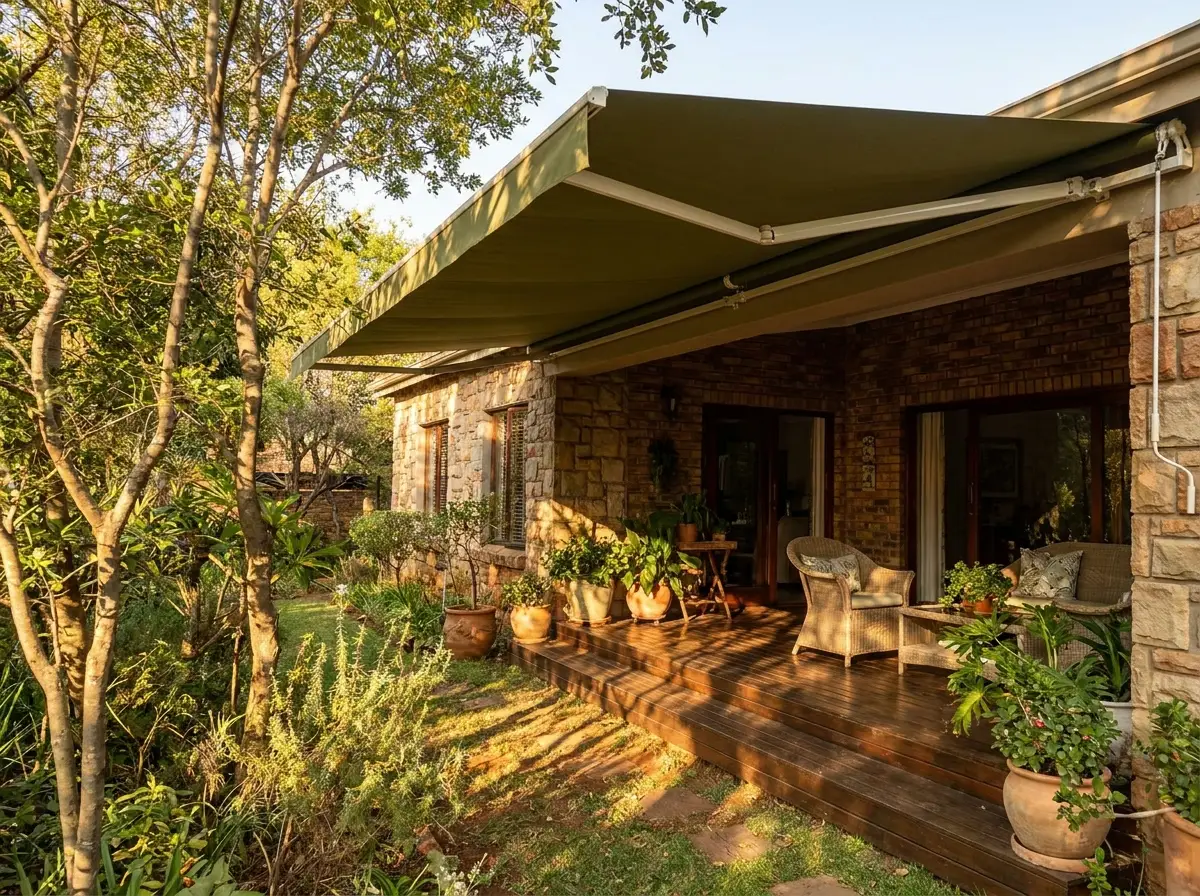
Groenkloof sits south-west of Brooklyn along the old diplomatic belt, backing directly onto the Groenkloof Nature Reserve — one of the few Pretoria suburbs where a back garden genuinely borders bushveld. Character homes here tend toward large stands, established indigenous gardens and, often, a deliberately unobtrusive street presence that suits the reserve edge and the diplomatic residences nearby.
Reserve-facing glass wants two things at once: a real view kept open for as much of the day as possible, and dependable shade for the hours the Highveld sun is at its hardest. A sunscreen roller in a low openness factor is the usual starting point on the reserve elevation, paired with a folding-arm awning over any patio or deck used for watching the light change over the treeline — wind-sensored, since an open terrace this close to the reserve boundary gets the full force of an afternoon storm with nothing to break it.
As with the rest of the old diplomatic belt, original stone and render facades get the same non-invasive, inside-or-outside-mount approach we use on Brooklyn's own heritage windows.
A reserve boundary changes what the blind has to do
A garden that ends at the reserve fence gives you something very few Pretoria addresses can: a long outlook with nobody’s window in it. That takes privacy off the list on that elevation and leaves glare and heat as the only real jobs, which is why a low-openness sunscreen — a 3% or 5% mesh — is where we usually start on the reserve side. The tight weave cuts glare and ultraviolet hard while still letting you read the treeline through it, and in a dark charcoal it goes close to transparent looking out while staying discreet looking in.
The street frontage of the same house often needs the reverse. Boundary walls and modest street-side openings are the norm along this stretch, and those rooms can end up dim rather than glary. A light-filter cloth or a cellular blind holds privacy there without dropping the room into permanent dusk, and the cell structure has the useful side effect of slowing heat loss on a cold July night behind a single-glazed pane.
Exposure, dust, and the limits we will tell you about
Backing onto open veld also means nothing upwind breaks the weather. A patio facing the reserve takes a storm front with no houses in front of it, which is why an awning here is specified with a motor and a wind sensor as standard practice rather than as an upsell. An awning that retracts itself the moment the wind picks up survives seasons; one that depends on somebody being home to wind it in does not. The same exposure brings veld dust and pollen, and that quietly steers fabric choice — a smooth blockout or a mesh wipes clean, where a deeply textured weave holds the grit.
Two honest limits worth saying before the measure rather than after. An awning is a shade product and not a roof: it will take light drizzle at a pitch and it will not take a Highveld downpour. And an older stone or rendered facade does not always accept a face-fixed bracket exactly where a drawing would want one, so on those houses we work off the reveal or the structure above it. Which of those applies to your windows is decided on site, and it goes into the written quote, window by window, before anything is ordered.
Get your Groenkloof home measured properly.
A free in-home consultation, real samples, and a written per-window quote — no obligation to go ahead.
Book your free measure